
Flexible Interconnection Studies for Large Loads: A use case for data center developers, flexibility solution providers, and utilities
A flexible interconnection study answers a question that traditional processes cannot: if a large load is willing to reduce its draw from the grid during stress events, how much capacity can it access, how often would those reductions occur, and for how long? This document describes how SAInt makes that question answerable, and what the answer means for each party.
The Challenge: A Question Nobody Could Answer (Until Now)
Large new loads, from data centers and advanced manufacturing to transport and building electrification, are flooding interconnection queues with requests for hundreds to thousands of megawatts. Timelines for new interconnections in many regions stretch five to eight years. Many developers are willing to avoid consuming energy from the grid during stress events in exchange for faster interconnection, but the fundamental question, what would those reductions actually look like and how often would they happen, is one that utilities do not yet have reliable tools to answer.
Traditional firm interconnection studies rely on a limited set of planning cases representing system operation at a few snapshots in time, typically peak demand conditions in each season. This approach determines whether the grid can always serve a new load at full capacity, which is the right question for an industrial facility or a commercial building. It is the wrong question for a new load that can shift workloads, operate on-site storage, or respond to grid signals.
Some grid operators now offer ‘connect and manage’ arrangements (e.g., ERCOT in North America) that allow loads to interconnect above available firm capacity, with the understanding that the operator can call for a reduction when needed. A load can often meet that call from behind-the-meter resources rather than halting operations. This is a step forward, but without quantifying the expected reductions, their frequency, duration, and timing across a period of system operation, neither the developer nor a flexibility solution provider can build a business case. An unbounded reduction commitment is not a term sheet; it is a risk with no limit.
Developers are asking a question utilities cannot answer. If I can be flexible, what does that change? SAInt is designed to answer that question with precision.
How SAInt Addresses This: From Snapshots to a Full Year of Operating Conditions
SAInt, encoord's integrated planning software, was developed specifically for economic and reliability planning problems that require iteration between security-constrained production cost modeling, AC power flow simulations, and contingency analysis. Flexible interconnection studies are a primary application.
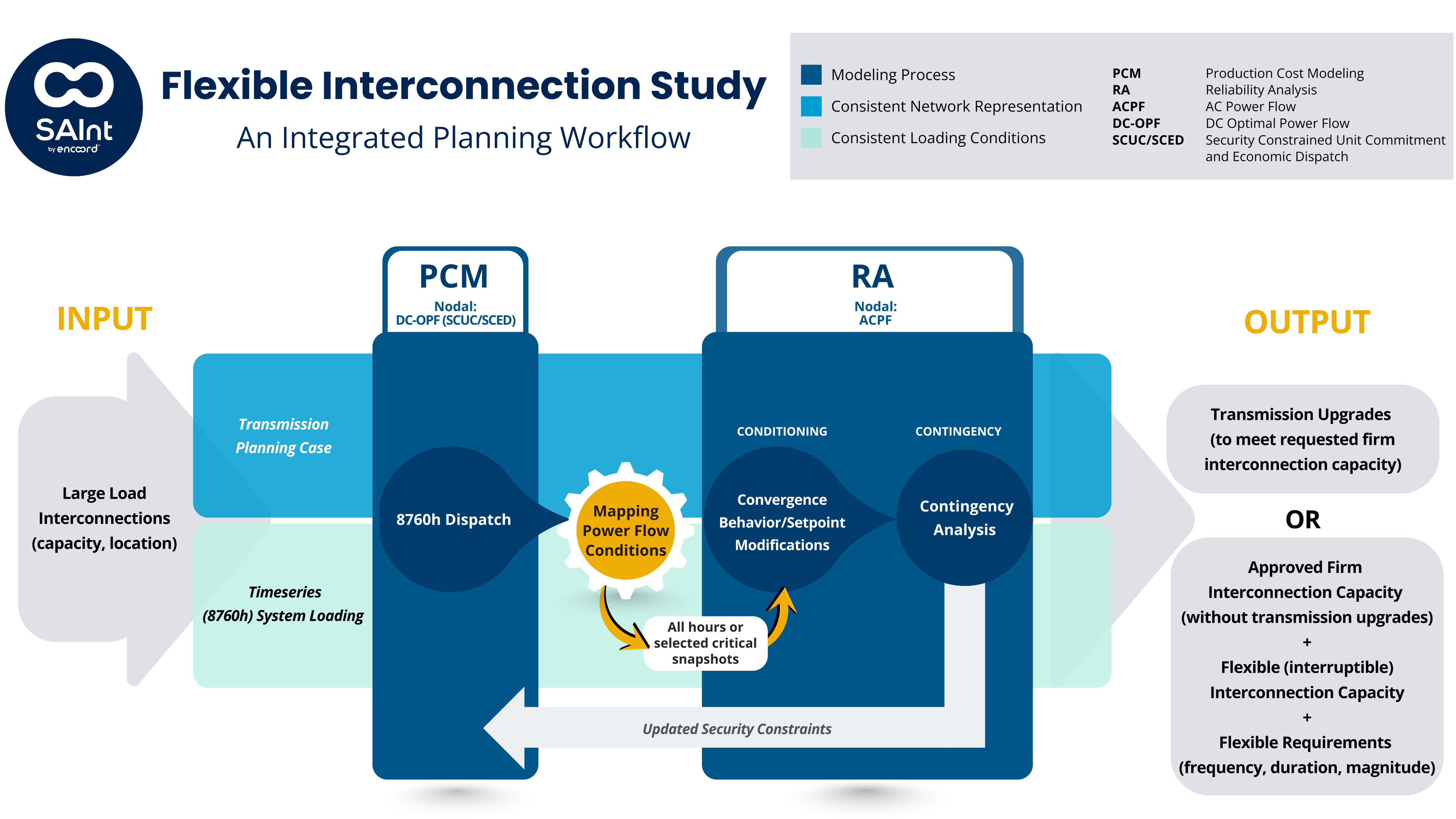
The foundation of each study is an Integrated Planning Model (IPM) that represents the operating condition of the grid across all 8,760 hours of the year, including all the inputs necessary to run security-constrained production cost models, AC power flow simulations, and contingency analyses. SAInt's Integrated Planner ensures consistent mapping between varying generator dispatch decisions and network constraints, maintaining data integrity across the full iterative process.
By running this workflow across all hours of the year and considering all relevant contingencies defined by NERC reliability standards, SAInt produces a specific flexibility profile for each candidate interconnection. Results are traceable and auditable (i.e., not “black box”) and do not rely on opaque algorithms, making them defensible for regulatory filings and counterparty negotiations. Because the same workflow runs identically for any candidate location, results are directly comparable across sites, which supports location screening before a formal interconnection request is submitted.
Inputs and Outputs
A SAInt flexible interconnection study requires: a transmission planning case, generator operational data and time-series for load, wind and solar power, and interties, the candidate substations, new interconnected load capacity, and the applicable contingency set. It produces:
Firm hosting capacity at each candidate location.
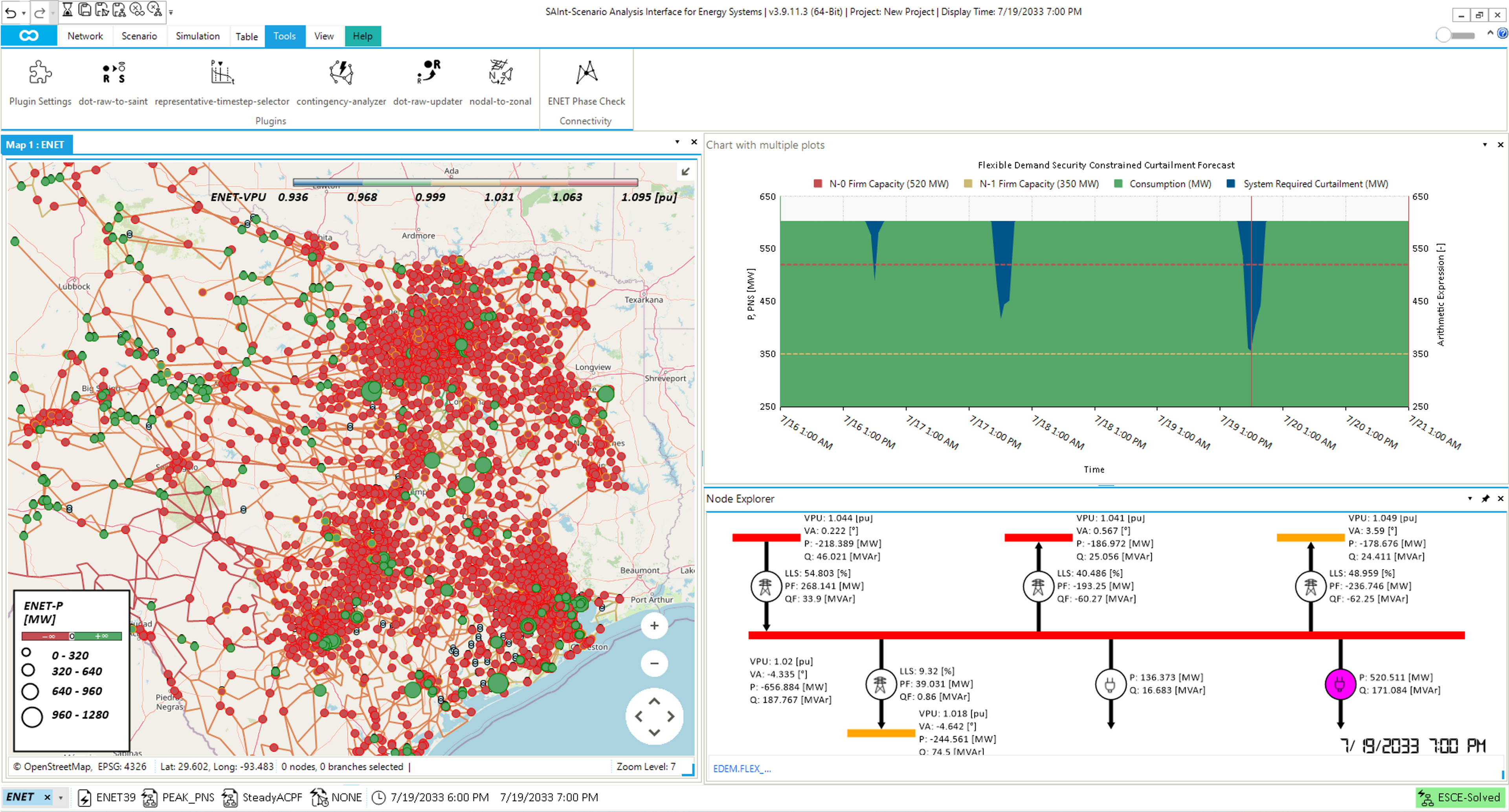
A full-year hourly (8,760-hour) flexibility profile: when reductions would occur, characterizable by month and time of day, along with event frequency and duration.
A probabilistic view of the same profile: a range of expected reduction risk per hour that accounts for generator forced outages and other operating uncertainties.
Unlocked interconnection capacity as a function of flexibility level or on-site resource type.
Results across multiple interconnection scenarios and future system states.
Study timelines
Individual flexible interconnection studies in SAInt can be completed in days to weeks. Several utilities have recognized the potential to compress study times significantly and to use the same workflow to evaluate new requests and requirements in a rapidly changing environment. For utilities managing growing volumes of large-load requests, SAInt's API and advanced clustering techniques enable the same workflow to serve as the core of a repeatable, automated screening process across many sites and scenarios simultaneously.
SAInt has been adopted by multiple utilities, system operators, developers, and consulting firms across North America to advance grid planning processes.
Bound the question for your system
Whether you are screening interconnection sites, sizing a flexibility solution, or building a flexible load interconnection process, encoord can quantify the flexibility offer with SAInt.
Talk to us: encoord.com/company/contact-us
Start a free SAInt trial: encoord.com/community/saint-trial