
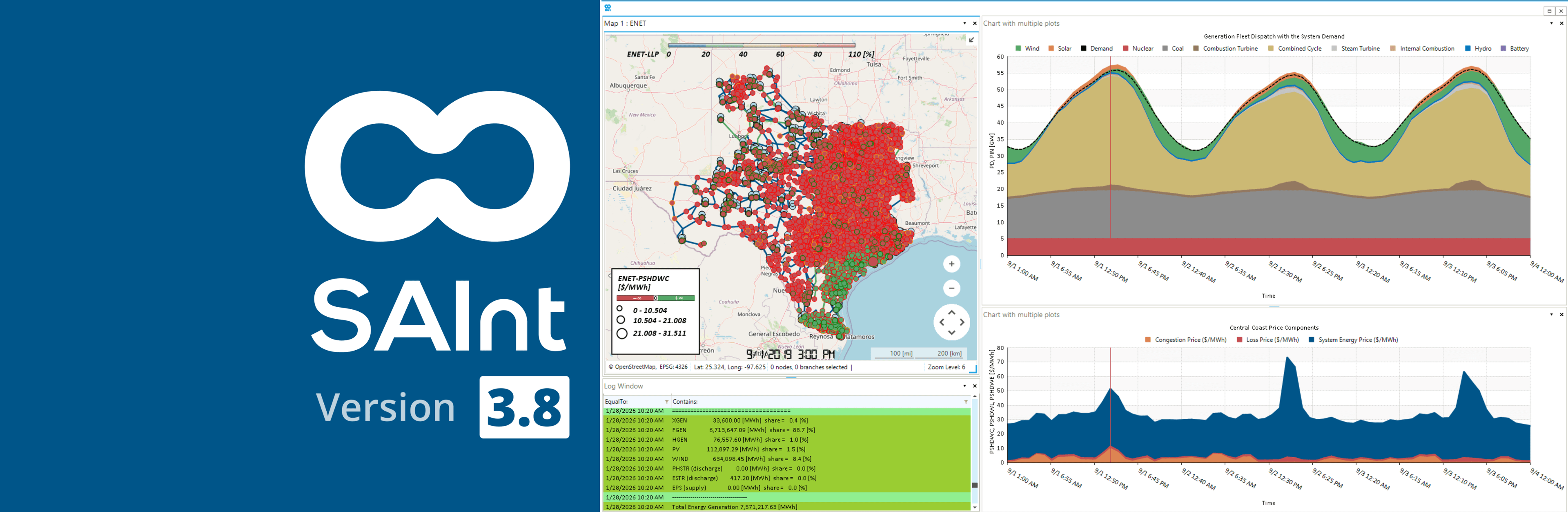
With a new year it is time for a new version of SAInt; the encoord team proudly presents SAInt 3.8!
Highlights of SAInt 3.8
The new features and additions in SAInt 3.8 are singularly focused at bolstering the integrated electric generation and transmission planning capabilities of the tool. The integrated planner greatly increases the flexibility and ease of moving between production cost modeling and AC power flow scenarios. The system balance formulation unlocks locational marginal price component breakdowns, market modeling for large nodal systems, and most importantly the security constrained unit-commitment economic dispatch capability. Power flow additions include remote node voltage control and switched shunts, plus a light loading algorithmic functionality and other helpful solver additions. Combined with an array of performance improvements across network and scenario loading, modifying, and executing, SAInt is now the electric system planner’s one stop shop for meaningful and effective generation and transmission integrated planning activities.
Integrated Planning
The newly introduced Integrated Planner allows users to effectively transfer outputs and inputs between different electric scenarios and types. Generating an ACPF snapshot including unit commitment and ancillary service contributions from a production cost model run is now as simple as a single button click. The Integrated Planner is fully customizable, boasting selective transfer options, scaler modifications, and optional time-window downscaling.
Generation Dispatch, Commitment, and Ancillary Services –
rapidly check the AC power flow response of economically optimized dispatch, commitment, and ancillary service contributions of continental power systems.
Distributed Energy Resource Behavior –
fleet responses of distributed energy resources to bulk power system and local feeder constraints can be co-optimized and then seamlessly checked for voltage behavior in unbalanced AC power flow simulations.
Time Period Down Selection –
users can now easily down select time segments of larger production cost model time windows maintaining full system configuration.
Day Ahead to Hourly Unit Commitment –
day ahead generator commitment optimizations can be easily fixed for hour ahead or real time optimizations, including optimal generator loss contingency responses.
Market Optimizations
Production cost modeling users can now select a system balance formulation, providing a locational marginal price breakdown of the loss, congestion, and loss components.
Security Constrained Unit-Commitment Economic Dispatch –
SAInt now fully supports the inclusion of network contingencies using the new Contingency and Monitored Branch objects.
Detailed PCM Objective Breakdown –
expanded PCM logging to provide detailed breakdowns of VOM costs, penalty costs, and other objective components for improved transparency and analysis.
Network Modeling
SAInt 3.8 boasts numerous additions to the network modeling capabilities and solver features in the DC and AC power flow domains. Also generally helpful is the newly introduced network change tracking tool.
Sensitivity Factor Queries –
users can now access injection shift factors and line outage distribution factors for enhanced analysis and diagnostics.
Remote Node Voltage Control –
remote-node voltage regulation in (U)ACPF, allowing generators and transformers to regulate voltage at a specified remote node with proper handling when multiple generators share the same target.
Voltage-Controlled Shunt Support –
single-level support for voltage-controlled shunt devices with new associated control properties and a simple deadband-based control logic.
Light-Loading Solver Algorithm –
a method added to improve the convergence of large ACPF models from flat start conditions.
Plugin Ecosystem
The plugin system has been streamlined with more user-friendly input forms, clear logging, and a new HTML viewer for displaying plugin reports. Additionally, numerous endpoints for creating and modifying network objects, saving networks and scenarios, managing scenario events and profiles, and retrieving pointers to key objects for programmatic workflows have been added. The release of SAInt 3.8 is also joined by a host of new plugins and major updates to existing plugins.
Dot Raw to SAInt –
major improvements have been made to this core translation tool, which can now execute a full translation of the MMWG and WECC eastern and western interconnection models, respectively.
Nodal to Zonal –
users can now convert a full transmission detail model into a zonal representation, with intertie capacities and impedances calculated with network reduction techniques.
Dot Raw Updater –
a new plugin that will generate updated dot raw files from an ACPF .enet and .esce pair for analysis in other tools.