
Power and Gas Infrastructure Coordination - Ensuring System-Wide Reliability and Affordability
Gain a system-wide view of how gas and power infrastructure interact. Model cross-sector dependencies, uncover operational bottlenecks, and make coordinated investment and planning decisions — all with a single software.
The Challenge

Power and Gas Coordination with SAInt
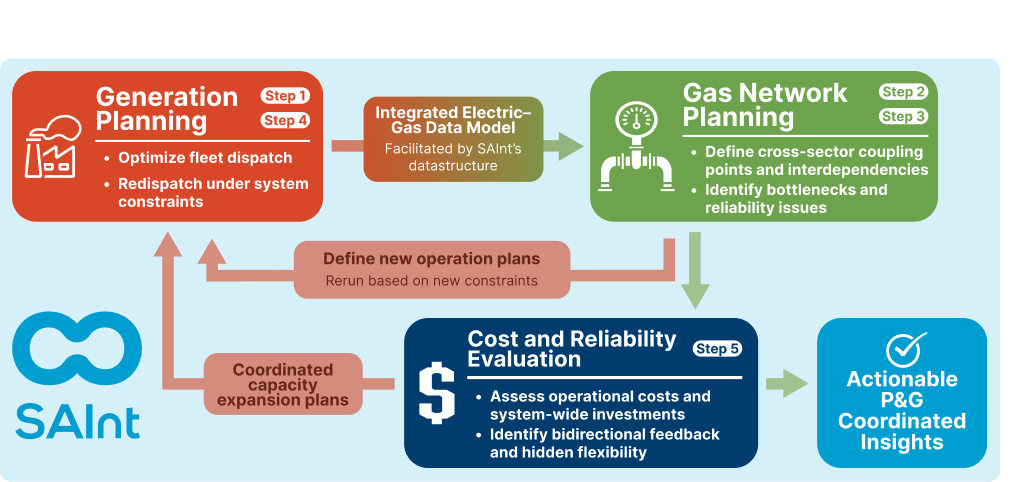
SAInt unifies electric generation and gas pipeline planning to capture their physical and operational interactions. It enables planners to detect vulnerabilities and mitigate cross-sector bottlenecks while optimizing planning decisions. This workflow supports the analysis of cascading risks, system flexibility, fuel supply adequacy, and the cost and reliability impact of different investment strategies.
See what SAInt can do
Schedule a demo to see how SAInt connects power system planning with gas network simulation in one integrated workflow.

Step 1: Generation Fleet Optimization
Optimize electric generation fleet dispatch for current and future operating conditions using nodal or zonal production cost models. SAInt incorporates ancillary services, fuel availability, and customizable operational constraints to quantify market performance, system flexibility, and fuel consumption patterns.
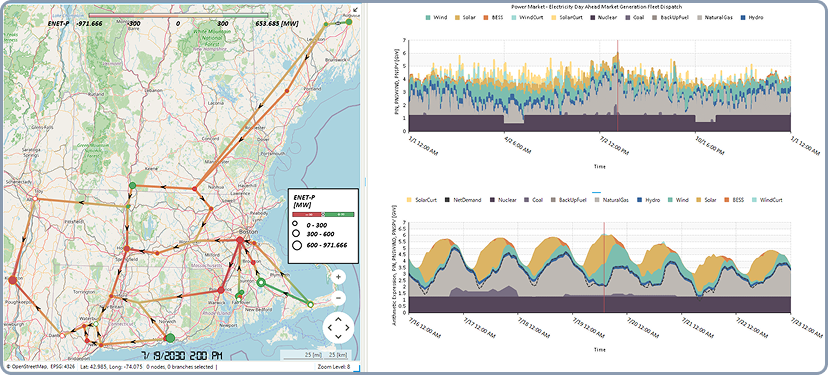
Image: Annual and peak week generation fleet dispatch shows significant participation of variable solar and wind resources, along with the complementary behavior of thermal assets.
Step 2: Use Optimization Outputs to Inform Gas Simulation
Overlay electric and gas infrastructures to identify cross-sector interactions and critical coupling points. SAInt translates electric dispatch results into equivalent gas operational conditions and constraints. This integrated framework enables direct operational characterization, including capturing gas-fired generator consumption tied to local fuel demand, electricity use for gas compression, and electrolyzer loading and efficiency expressed as gas flow and pressure, to ensure an accurate, system-wide representation of energy flows and constraints.
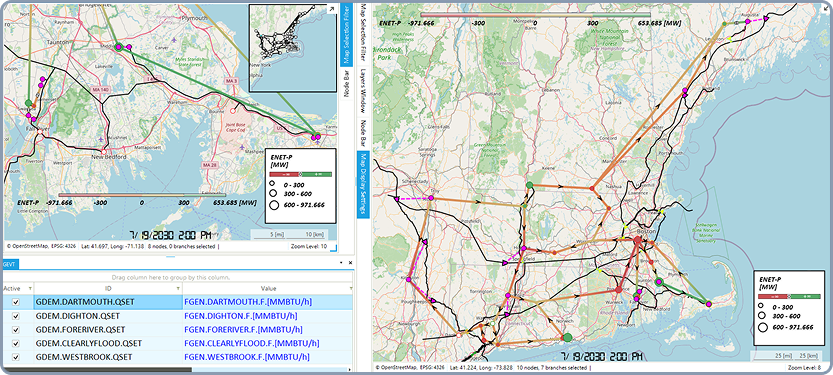
Image: Define coupling points between power and gas systems and translate generator fuel consumption into gas demand.
Step 3: Identify Hidden Gas Network Constraints and Reliability Issues
Evaluate the downstream impacts of electric dispatch using gas hydraulic simulations to understand how fuel supply dynamics and infrastructure constraints affect system performance under varying gas compositions (e.g., natural gas, hydrogen, or blends). SAInt identifies when and where flow, pressure, or gas quality limits occur and how they affect fuel delivery and availability. By pinpointing issues such as restricted linepack, compressor limits, or variations in fuel quality, planners can identify conditions that may compromise generation reliability and system flexibility.
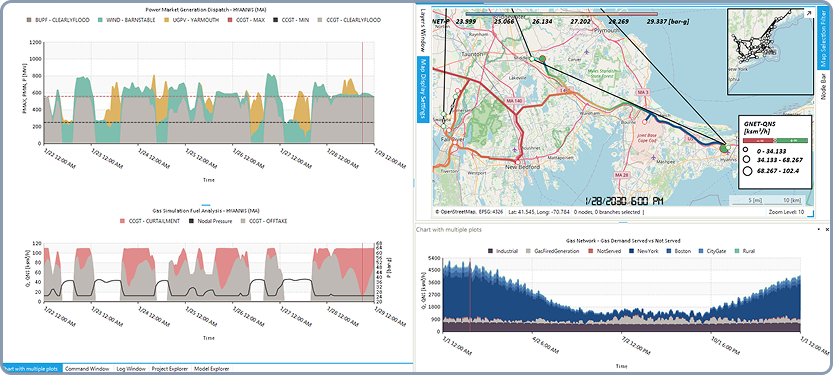
Image: Fuel availability analysis shows a gas curtailment due to the minimum delivery pressure constraint at the gas-fired generator off-take site.
Step 4: Generation Redispatch Informed by Gas Constraints
Integrate gas pipeline constraints into generation dispatch decisions to accurately capture the impact of fuel supply limitations on system reliability and generation performance. This includes assessing the economic implications of backup solutions and alternative fuel strategies. SAInt enables planners to run new scenarios with updated assumptions and constraints (e.g., fuel availability, quality variations, back-up fuel, and electric loading for gas compression), thereby grounding cost analyses in realistic system conditions and uncovering hidden costs from cross-sector bottlenecks.
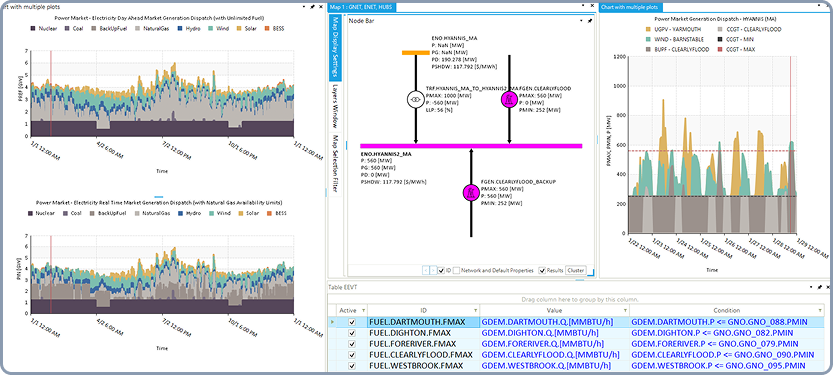
Image: Forecasted day-ahead market dispatch will lead to real-time backup fuel reliance because of gas system constraints. A coordinated strategy can address this issue.
Step 5: Financial and Operational Impact of a Coordinated Strategy
Quantify both visible and hidden costs associated with new technologies, capacity expansion, and added flexibility. SAInt helps identify cross-sector redundancies and prioritize critical infrastructure investments that lower operational costs while enhancing the reliability and coordination of electric and gas networks, in turn enabling a more reliable, affordable system.
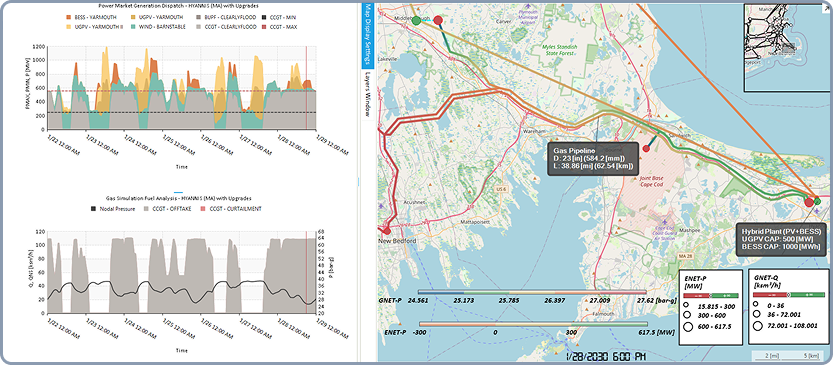
Image: Coordinated reinforcement by building a new pipeline to increase linepack and developing a hybrid plant to reduce generator ramping, ensuring minimum delivery pressure at off-take site.
The Value of Power and Gas Coordination with SAInt
Reliable, Affordable Energy Supply
Visualize and unify power and gas infrastructure data in one SAInt model. Run integrated studies without manual handoffs or mismatched assumptions, improving data integrity, streamlining workflows, and speeding executive decisions.
Prioritize High-Value Investments
Evaluate investment strategies based on real operational and network constraints to ensure capital goes to upgrades that improve reliability, reduce costs, and strengthen coordination across sectors.
Identify and Mitigate Risks
Plan across thousands of operating conditions, far beyond traditional scenarios. SAInt uncovers hidden vulnerabilities, dispatch patterns, cross-sector dependencies, and feedback effects, enabling proactive, risk‑informed planning.
See More
Watch a webinar from encoord and NREL focusing on the risks of gas insecurity
The U.S. power sector’s reliance on natural gas pipelines, alongside growing wind and solar adoption, has heightened the need for coordinated planning between gas and electric networks to prevent costly and dangerous outages. In this webinar, encoord and NREL experts share study results using SAInt to show how optimizing both systems can help mitigate gas insecurity during extreme weather events.
▶
Read publications about SAInt’s Integrated Power and Gas Infrastructure Coordination in action
➡️ The Hidden Flexibility of the Natural Gas Network for Electric Power Operations: A Case Study of a Near-Miss Winter Event, A. Fay, et al., NREL Technical Report, 2023.
➡️ The Value of Gas Network Modeling on Electricity System Operations, W. Frazier, et al., EPRI Technical Report, 2022.
➡️ An Evaluation of Co-Simulation for Modeling Coupled Natural Gas and Electricity Networks, B. Sergi, et al., Energies, 2022.
➡️ Coordinated operation of electricity and natural gas systems from day-ahead to real-time markets, O. J. Guerra, et al., Journal of Cleaner Production, 2020.
➡️ Integrated Model of Natural Gas Pipelines and the Electricity Grid, B. Hodge, et al., JISEA Research Highlight, 2020.
➡️ Electric Power Grid and Natural Gas Network Operations and Coordination, O. J. Guerra, et al., NREL Technical Report, 2020.
➡️ Valuing intra-day coordination of electric power and natural gas system operations, M. Craig, et al., Energy Policy, 2020